The Greeks Believe in the Study of the Arts Dance Music Sculpture Why?

The music of aboriginal Hellenic republic was most universally present in aboriginal Greek society, from marriages, funerals, and religious ceremonies to theatre, folk music, and the ballad-like reciting of epic poesy. It thus played an integral role in the lives of ancient Greeks. In that location are some fragments of actual Greek musical notation,[1] [two] many literary references, depictions on ceramics and relevant archaeological remains, such that some things can be known—or reasonably surmised—well-nigh what the music sounded like, the general role of music in society, the economics of music, the importance of a professional degree of musicians, etc.
The discussion music comes from the Muses, the daughters of Zeus and patron goddesses of creative and intellectual endeavours.
Concerning the origin of music and musical instruments: the history of music in aboriginal Greece is so closely interwoven with Greek mythology and legend that information technology is often hard to surmise what is historically true and what is myth. The music and music theory of aboriginal Greece laid the foundation for western music and western music theory, every bit information technology would continue to influence the aboriginal Romans, the early Christian church and the medieval composers.[3] [ folio needed ] Specifically the teachings of the Pythagoreans, Ptolemy, Philodemus, Aristoxenus, Aristides, and Plato compile most of our understanding of ancient Greek music theory, musical systems, and musical ethos.
The study of music in aboriginal Hellenic republic was included in the curriculum of great philosophers, Pythagoras in particular believed that music was subject to the same mathematical laws of harmony every bit the mechanics of the cosmos, evolving into an idea known as the music of the spheres.[3] [ page needed ] The Pythagoreans focused on the mathematics and the acoustical science of audio and music. They developed tuning systems and harmonic principles that focused on simple integers and ratios, laying a foundation for acoustic science; however, this was non the only school of thought in aboriginal Greece.[3] [ folio needed ] Aristoxenus, who wrote a number of musicological treatises, for example, studied music with a more empirical tendency. Aristoxenus believed that intervals should be judged by ear instead of mathematical ratios,[4] though Aristoxenus was influenced past Pythagoras and used mathematics terminology and measurements in his research.
Music in society and religion [edit]

Music played an integral role in ancient Greek society. Pericles' teacher Damon said, according to Plato in the Republic, "when fundamental modes of music change, the fundamental modes of the state change with them." Music and gymnastics comprised the main divisions in one's schooling. "The word 'music' expressed the entire teaching".[5]
Instrumental music served a religious and entertaining part in ancient Hellenic republic as it would often accompany religious events, rituals, and festivals. Music was also used for entertainment when it accompanied drinking-parties or symposia. A popular type of piece to exist played while drinking at these drinking parties was the skolion, a piece composed to be heard while drinking.[half dozen] Earlier and after the Greek drinking parties, religious libations, or the religious the act of partaking and pouring out drink, would be made to deities, usually the Olympic gods, the heroes, and Zeus. The offer of libations were often accompanied past a special libation melody called the spondeion, which was oftentimes accompanied past an aulos player.[3] [ page needed ]
Music occupied an of import function in the Greek sacrificial ceremonies. The sarcophagus of Hagia Triada shows that the aulos was present during sacrifices as early as 1300 BC.[vii] [ folio needed ] Music was besides present during times of initiation, worship, and religious celebration, playing very integral parts of the sacrificial cults of Apollo and Dionysus.[7] [ page needed ]
Music (forth with intoxication of potions, fasting, and beloved) was also integral in preparing for and catalyzing divination, every bit music would oft induce prophets into religious ecstasy and revelation, so much then that the expression for "making music" and "prophesying" were identical in ancient Greek.[7] [ page needed ]
Instruments were also present in state of war time, though information technology may not have been considered music entirely. Specific notes of the trumpet were played to dictate commands to soldiers on the battlefield. The aulos and percussion instruments too accompanied the exact commands given to oarsmen past the boatswain. The instruments were used mainly to help keep the oarsmen in fourth dimension with i another.[3] [ page needed ]
Pop song types [edit]
- Hymn
- A hymn is a metric composition whose text addresses a god, either directly or indirectly. They are the earliest formal type in Greek music, and survive in relatively large numbers.[8] : 29–30
- Paean
- Paeans were most unremarkably sung in award or worship of Apollo as well every bit Athena. They usually solemnly expressed the hope for deliverance from a peril, or were sung in thanksgiving afterward a victory or escape.[3] [ page needed ]
- Prosodion
- A blazon of hymn or processional that invoked or praised a god. Prosodions were usually sung on the road to an chantry or shrine, before or afterwards a paean.[3] : 3
- Hyporchema
- Hyporchema was a dance-song with a marked rhythmic move, usually associated with the paean, and ofttimes difficult to distinguish from it. For instance, the First Delphic Hymn is titled "Paean or Hyporchema".[8] : 88
- Dithyrambs
- Usually merrily sung in celebration at festivals, performed especially in dedication to Dionysus, the god of wine. Dithyrambs featured choirs (choros) of men and boys who were accompanied past an aulos actor.[3] [ page needed ]
Poetry and drama [edit]
Whether or not long narrative poetry, or ballsy poetry like those of Homer, was sung is not entirely known. Equally in Plato's dialogue Ion, Socrates uses both the words "sing" and "speak" in connection with the Homeric epics,[9] [ page needed ] however in that location are heavy implications that they have been at least recited unaccompanied by instruments, in a sing-song dirge.[3] [ page needed ]
Music was besides present in ancient Greek lyric poetry, which by definition is poetry or a song accompanied past a lyre. Lyric poetry eventually branched into two paths, monodic lyric which were performed past a singular person, and choral lyric which were sung and sometimes danced by a grouping of people choros. Famous lyric poets include Alkaios and Sappho from the Island of Lesbos, Sappho being one of the few women whose verse has been preserved.[3] [ folio needed ]
Music was besides heavily prevalent in aboriginal Greek Drama. In his Poetics, Aristotle links the origins of tragic drama to dithyrambs.[10] The leaders of dithyrambs were the ones who led the vocal and trip the light fantastic moves, which would and then be responded to by the group. Aristotle implies that this relationship between a single person and a grouping began the tragic drama, which in its earliest stages had a single role player who played all the parts through either song or speech. The single actor engaged in dialogue with the choros. The choros narrated most of the story through song and trip the light fantastic toe. In ancient Greece, the playwright was expected to not only write the script but also expected to compose the music and trip the light fantastic toe moves.[3] [ page needed ]
Mythology [edit]
The ancient Greek myths were never codification or documented into one form; what exists are several different versions from several unlike authors, across multiple centuries, which tin can lead to variations and even contradictions amid authors and fifty-fifty the same author. According to Greek mythology, music, instruments, and the aural arts are attributed to divine origin, and the fine art of music was souvenir of the gods to men.[iii] [ page needed ]
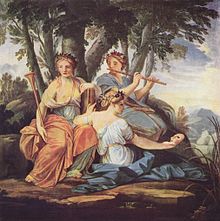
A 17th-century representation of the Greek muses Clio, Thalia, and Euterpe playing a transverse flute, presumably the Greek photinx.
Although Apollo was prominently considered the god of music and harmony, several legendary gods and demigods were purported to have created some aspect of music too every bit contributed to its development. Some gods, and especially the Muses, represented specific aspects or elements of music. The 'inventions' or 'findings' of all ancient Greek instruments were accredited to the gods equally well. The performance of music was integrated into many different modes of Greek story-telling and art related to mythology, including drama, and poetry, and there are a large number of ancient Greek myths related to music and musicians.[three] [ page needed ]
In Greek mythology: Amphion learned music from Hermes and then with a golden lyre built Thebes by moving the stones into place with the sound of his playing; Orpheus, the chief-musician and lyre-player, played so magically that he could soothe wild beasts; the Orphic creation myths have Rhea "playing on a brazen drum, and compelling man'south attention to the oracles of the goddess";[11] : 30 or Hermes [showing to Apollo] "... his newly-invented tortoise-shell lyre and [playing] such a ravishing tune on it with the plectrum he had also invented, at the same time singing to praise Apollo'south nobility[11] : 64 that he was forgiven at once ..."; or Apollo's musical victories over Marsyas and Pan.[xi] : 77
At that place are many such references that indicate that music was an integral part of the Greek perception of how their race had even come up into existence and how their destinies continued to be watched over and controlled by the Gods. Information technology is no wonder, and then, that music was omnipresent at the Pythian Games, the Olympic Games, religious ceremonies, leisure activities, and even the beginnings of drama equally an outgrowth of the dithyrambs performed in award of Dionysus.[12]
It may exist that the bodily sounds of the music heard at rituals, games, dramas, etc. underwent a change subsequently the traumatic fall of Athens in 404 BC at the end of the starting time Peloponnesian War. Indeed, i reads of the "revolution" in Greek culture, and Plato's complaining that the new music "... used high musical talent, showmanship and virtuosity ... consciously rejecting educated standards of judgement."[thirteen] Although instrumental virtuosity was prized, this complaint included excessive attending to instrumental music such as to interfere with accompanying the human vox, and the falling away from the traditional ethos in music.
Mythical origins [edit]

- Lyre
- Co-ordinate to the Homeric Hymn to Hermes, after stealing his brother Apollo's sacred cattle, Hermes was inspired to build an musical instrument out of a tortoise shell; he fastened horns, and gut-string, to the shell and invented the first lyre. Afterwards, Hermes gave his lyre to Apollo, who took interest in the instrument, in repayment for the stolen cattle. In other accounts, Hermes gave his newly invented lyre to Amphion, a son of Zeus and a skilled musician.[14]
- Aulos
- According to Pindar's 12th Pythian Ode, later on Perseus beheaded Medusa, Athena 'plant' or 'invented' the aulos in order to reproduce the lamentation of Medusa's sisters. Since the same Greek discussion is used for 'detect' and 'invent', it is unclear; still, the author Telestes in the fifth century states that Athena found the instrument in a thicket. In Plutarch'southward essay On the Restraint of Anger, he writes that Athena, afterwards seeing her reflection while playing the aulos, threw the instrument away because it distorted her facial features when played, after which Marsyas a satyr, picked up her aulos and took it up equally his own.[fifteen]
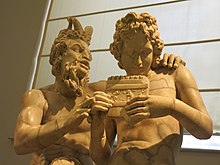
- Syrinx / Pan flute
- According to Ovid'southward Metamorpheses, the original Syrinx was a Naiad, a h2o nymph, who ran abroad from Pan after he tried to woo her. While she fled, she came upon an uncrossable river and prayed to her sisters to transform her so that she may escape Pan. Her Nymph sisters transformed Syrinx into a bundle of reeds which Pan plant and fashioned an instrument out of, the Pan flute or syrinx.[16]
Orpheus myth [edit]
Orpheus is a significant effigy in the ancient Greek mythology of music. Orpheus was a legendary poet and musician, his lineage is unclear equally some sources note him as the son of Apollo, the son of the Muse Calliope, or the son of mortal parents. Orpheus was the educatee and brother of Linus. Linus by some accounts is the son of Apollo and the Muse Urania; Linus was the commencement to exist gifted the power to sing by the Muses, which he passed to Orpheus. Other accounts land that Apollo gave Orpheus a aureate lyre and taught him to play, while the muses taught Orpheus to sing.
Orpheus was said to exist such a skilled musician that he could charm inanimate objects.[iii] [ folio needed ] According to the Argonautica, Orpheus in his adventures with Jason and the Argonauts, was able to play music more cute and louder than the bewitching sirens, allowing the Argonauts to travel safely without being charmed past the sirens.[17] When Orpheus' wife, Eurydice, died, he played a vocal so mournful that it caused the gods and all the nymphs to cry. Orpheus was so able to travel to the underworld, and with music, softened the heart of Hades enough that he was allowed to return with his married woman; however, nether the condition that he must not set eyes upon his married woman until they finished their travel out of the underworld. Orpheus was unable to fulfill this condition and tragically, his wife vanished forever.[iii] [ page needed ] [18]
Marsyas myth [edit]

According to Pseudo-Apollodorus in Bibliotheca, Marsyas the Phrygian satyr once boasted of his skills in the aulos; a musical contest between Marsyas and Apollo was then conducted, where the victor could do "whatever they wanted" to the loser.[19] Marsyas played his aulos so wildly that everyone burst into trip the light fantastic, while Apollo played his lyre and so beautifully that anybody cried.
The muses judged the commencement round to be a draw. According to ane business relationship, Apollo and so played his lyre upside downward, which Marsyas could not practise with the aulos. In another account Apollo sang beautifully, which Marsyas could non do. In another account, Marsyas played out of melody and accepted defeat. In all accounts, Apollo then flayed Marsyas alive for losing.
Pindar recounts a like myth but instead of Marsyas, it was Pan who contests Apollo and the judge was Midas. This myth tin can be considered a testament of Apollo's skill merely also a myth of caution towards pride.[xx]
Greek musical instruments [edit]
The following were amid the instruments used in the music of aboriginal Greece. The lyre, cithara, aulos, barbiton, hydraulis, and salpinx all found their manner into the music of ancient Rome.
String [edit]
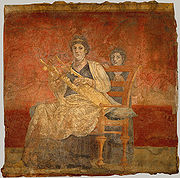
A afterward vivid Roman representation of a adult female playing the kithara
- Lyre
- A strummed and occasionally plucked string musical instrument, substantially a paw-held zither built on a tortoise-shell (chelys) frame, generally with seven or more strings tuned to the notes of one of the modes. The lyre was a folk-instrument, associated with the cult of Apollo. It was used to accompany others or fifty-fifty oneself for recitation and vocal, and was the conventional training-instrument for an aristocratic education.
- Cithara
- Cithara was a professional person version of the lyre used by paid musicians.[a] [b]
- Barbiton
- A larger, bass-version of the cithara, considered to exist due east-Ionian, an exotic and somewhat foreign instrument. The barbiton was the primary instrument of the highly regarded ancient lyricist Sappho, likewise equally often associated with satyrs.
- Kanonaki
- A trapezoidal psaltery, invented by the Pythagoreans in the 6th century BC, however, may have had Mycenaean origins. The kanonaki was held on the thighs of the player, and plucked with both hands with bone pickings.
- Harp
- Harps are among the oldest known string instruments, and were in use by Sumerians and Egyptians long before they were nowadays in Greece. The ancient version of the harp resembles a bow, with the strings connecting to the summit and lesser of the arch. The strings are perpendicular to the soundbox, while the strings on a lyre are parallel.[21]

The hydraulis. Notation the presence of the curved trumpet, chosen the bukanē by the Greeks and, subsequently, cornu past the Romans.
Air current [edit]
- Aulos
- Usually double, consisting of two double-reed (like an oboe) pipes, not joined but generally played with a oral fissure-ring to hold both pipes steadily between the actor's lips. Modernistic reconstructions of the aulos signal that they produced a low, clarinet-like sound. In that location is some confusion nigh the exact nature of the instrument; alternate descriptions betoken single-reeds instead of double reeds. It was associated with the cult of Dionysus.
- Syrinx or Pan flute
- (Greek συριγξ, syrinx), also known as Pan flute, is an ancient musical instrument based on the principle of the stopped pipe, consisting of a series of such pipes of gradually increasing length, tuned (by cutting) to a desired scale. Audio is produced past blowing across the summit of the open pipe (similar blowing across a bottle peak).
- Hydraulis
- A keyboard instrument, the forerunner of the mod pipage organ. As the name indicates, the hydraulis used water to supply a abiding catamenia of pressure to the pipes. 2 detailed descriptions accept survived: that of Vitruvius[22] and Heron of Alexandria.[23] These descriptions deal primarily with the keyboard mechanism and with the appliance that supplied the musical instrument with air.[c]
- Salpinx
- A brass trumpet used for military calls, and even contested in the Olympics. A number of sources mention this metallic instrument with a os mouthpiece.
Percussion [edit]
- Tympanum
- Tympanum, besides chosen tympanon, is a type of frame drum or tambourine. It was circular, shallow, and beaten with the palm of the hand or a stick.
- Crotalum
- The crotalum was a kind of clapper or castanet used in religious dances past groups.
- Koudounia
- The Koudounia are bell-like percussion instruments made of copper.
Music and philosophy [edit]
Pythagoras [edit]
The enigmatic aboriginal Greek figure of Pythagoras with mathematical devotion laid the foundations of our knowledge of the written report of harmonics—how strings and columns of air vibrate, how they produce overtones, how the overtones are related arithmetically to one another, etc.[25] It was common to hear of the "music of the spheres" from the Pythagoreans. Later studying the sound hammers made in a blacksmith'due south forge, Pythagoras invented the monochord, which has a movable bridge along with a cord stretched over a sounding board. Using the monochord, he establish the clan between the vibrations and the lengths of the strings.[26]
Plato [edit]
At a sure signal, Plato complained near the new music:
Our music was one time divided into its proper forms ... It was not permitted to commutation the melodic styles of these established forms and others. Knowledge and informed judgment penalized disobedience. There were no whistles, unmusical mob-noises, or clapping for adulation. The rule was to mind silently and learn; boys, teachers, and the crowd were kept in order by threat of the stick. ... Simply later, an unmusical anarchy was led past poets who had natural talent, just were ignorant of the laws of music ... Through foolishness they deceived themselves into thinking that there was no right or wrong way in music, that it was to be judged expert or bad by the pleasure information technology gave. By their works and their theories they infected the masses with the presumption to think themselves acceptable judges. So our theatres, once silent, grew vocal, and aristocracy of music gave manner to a pernicious theatrocracy ... the criterion was not music, but a reputation for promiscuous cleverness and a spirit of police-breaking.[27]
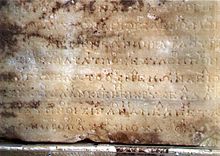
Photograph of the original stone at Delphi containing the 2d of the 2 hymns to Apollo. The music annotation is the line of occasional symbols above the main, uninterrupted line of Greek lettering.
From his references to "established forms" and "laws of music" nosotros tin assume that at least some of the formality of the Pythagorean system of harmonics and consonance had taken hold of Greek music, at least as information technology was performed by professional musicians in public, and that Plato was lament about the falling away from such principles into a "spirit of constabulary-breaking".
Playing what "sounded good" violated the established ethos of modes that the Greeks had developed past the time of Plato: a complex arrangement of relating certain emotional and spiritual characteristics to certain modes (scales). The names for the various modes derived from the names of Greek tribes and peoples, the temperament and emotions of which were said to be characterized by the unique audio of each mode. Thus, Dorian modes were "harsh", Phrygian modes "sensual", and then forth. In his Republic,[28] Plato talks about the proper use of various modes, the Dorian, Phrygian, Lydian, etc. It is hard for the modernistic listener to relate to that concept of ethos in music except past comparing our own perceptions that a minor scale is used for melancholy and a major scale for virtually everything else, from happy to heroic music.
The sounds of scales vary depending on the placement of tones. Modernistic Western scales use the placement of whole tones, such equally C to D on a modernistic piano keyboard, and half tones, such every bit C to C-sharp, but not quarter-tones ("in the cracks" on a modern keyboard) at all. This limit on tone types creates relatively few kinds of scales in mod Western music compared to that of the Greeks, who used the placement of whole-tones, half-tones, and even quarter-tones (or still smaller intervals) to develop a large repertoire of scales, each with a unique ethos. The Greek concepts of scales (including the names) constitute its style into later Roman music then the European Middle Ages to the extent that one can find references to, for example, a "Lydian church mode", although name is just a historical reference with no human relationship to the original Greek sound or ethos.
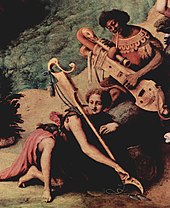
From the descriptions that have come down to us through the writings of those such as Plato, Aristoxenus[29] and, later, Boethius,[xxx] we tin can say with some caution that the ancient Greeks, at to the lowest degree before Plato, heard music that was primarily monophonic; that is, music congenital on unmarried melodies based on a system of modes / scales, themselves built on the concept that notes should exist placed between consonant intervals. It is a commonplace of musicology to say that harmony, in the sense of a developed system of composition, in which many tones at once contribute to the listener's expectation of resolution, was invented in the European Middle Ages and that ancient cultures had no adult system of harmony—that is, for example, playing the third and 7th higher up the ascendant, in order to create the expectation for the listener that the tritone volition resolve to the 3rd.
Plato'due south Commonwealth notes that Greek musicians sometimes played more than one notation at a time, although this was apparently considered an advanced technique. The Orestes fragment of Euripides seems to clearly call for more than i note to exist sounded at once.[31] Research[32] in the field of music from the ancient Mediterranean—decipherings of cuneiform music script—argue for the sounding of different pitches simultaneously and for the theoretical recognition of a "scale" many centuries before the Greeks learned to write, which they would have done before they developed their system for notating music and recorded the written evidence for simultaneous tones. All we tin can say from the available evidence is that, while Greek musicians clearly employed the technique of sounding more than one note at the same time, the nearly basic, common texture of Greek music was monophonic.
That much seems evident from another passage from Plato:
... The lyre should exist used together with the voices ... the player and the pupil producing annotation for note in unison, Heterophony and embroidery past the lyre—the strings throwing out melodic lines dissimilar from the melodia which the poet composed; crowded notes where his are sparse, quick time to his dull ... and similarly all sorts of rhythmic complications confronting the voices—none of this should be imposed upon pupils ...[33]
Aristotle [edit]

Girls dancing, with an instructress and a youth (well-nigh 430 BC), constitute at Capua. British Museum
Aristotle had a stiff belief that music should be a part of one's education, alongside reading and writing, and gymnastics. Just as men must piece of work difficult in their duties, they must besides be able to relax well. According to Aristotle, all men could hold that music was one of the most pleasurable things, and so to have this as a means of leisure was just logical. Amusing oneself was non considered a viable hobby, or else we would non want to help in society. Since music combined relaxing ourselves, along with others, Aristotle claimed that learning an instrument was essential to our development.[34] : ten
Virtues is a topic that Aristotle is widely known for, and he also used them to justify why music should be involved in education. Since virtues consist of loving and rejoicing in something, then music could be pursued without issue. Music forms our character, then it should also be a role of our teaching. Aristotle also comments on how getting children involved in music would be a way to go along them occupied and quiet. It is important to note that since music helps in forming the character, it could cause either adverse or pleasant effects. The way in which music is taught can accept a large impact on development.[34] : sixteen
Learning music should not interfere with the younger years, nor should it damage the torso in a manner that a person is unable to fulfill duties in the military. Those that take learned music in didactics should non exist at the same level every bit a professional, but they should have a greater knowledge than the slaves and other commoners.[34] : 15 Aristotle was specific in what instruments should be learned. The harp and flute should not exist taught in school, as they are likewise complicated. Additionally, only sure melodies have benefits in an educational setting. Upstanding melodies should be taught, but melodies of passion and melodies of activeness should be for performances.[34] : 16
Surviving music [edit]
Classical Period [edit]
- Eleusis inv. 907 (trumpet signal)
-
- Dionysius of Halicarnassus, Comp. 63 f.
- Euripides, Orestes, Papyrus Vienna G 2315
- Papyrus Leiden inv. P. 510 (Euripides, Iphigenia in Aulis)
Hellenistic Menstruation [edit]
- Papyrus Ashm. inv. 89B/31, 33
- Papyrus Ashm. inv. 89B/29-32 (citharodic nomes)
- Papyrus Hibeh 231
- Papyrus Zeno 59533
- Papyrus Vienna Thousand 29825 a/b recto
- Papyrus Vienna Thou 29825 a/b verso
- Papyrus Vienna Thousand 29825 c
- Papyrus Vienna Chiliad 29825 d-f
- Papyrus Vienna G 13763/1494
- Papyrus Berlin 6870
- Epidaurus, SEG thirty. 390 (Hymn to Asclepius)
Roman majestic menstruation [edit]
- Delphic Hymns
- Seikilos epitaph
- Hymns of Mesomedes
See also [edit]
- Nomos (music)
- Oxyrhynchus hymn
- Aboriginal Roman music
- For a technical discussion, Musical system of ancient Greece or Ancient Greek Musical Notation
Notes [edit]
- ^ In the Politics (1341a), Aristotle describes the kithara as an organon technikon, or an artist's instrument, requiring preparation.
- ^ The kithara had a box-blazon frame with strings stretched from the cross-bar at the top to the sounding box at the lesser; it was held upright and played with a plectrum. The strings were tunable by adjusting wooden wedges along the cross-bar.
- ^ A well-preserved Hydraulis model made of pottery was found at Carthage in 1885. Substantially, the air to the pipes that produce the sound comes from a wind-chest connected past a pipage to a dome; air is pumped in to shrink water, and the h2o rises in the dome, compressing the air, and causing a steady supply of air to the pipes.[24]
References [edit]
- ^ Henderson, p. 327.
- ^ Ulrich and Pisk, p. sixteen.
- ^ a b c d e f 1000 h i j k fifty m northward o Landels, John One thousand. (2001) [1999]. Music in Ancient Greece and Rome (pbk reprint ed.). Abingdon, United kingdom: Taylor & Francis. doi:10.4324/9780203270509. ISBN0-415-24843-four. ISBN 978-0-203-27050-ix [ dead link ] Landels, John 1000. (31 January 2002). Express online preview. ISBN9780203042847 – via Google Books.
- ^ Bélis, Annie (2001). Aristoxenus. Oxford Music Online. Vol. 1. Oxford University Press. doi:x.1093/gmo/9781561592630.commodity.01248.
- ^ Edmond Pottier (1908). Douris and the Painters of Greek Vases. p. 78.
- ^ Katz, Israel J. (2001). Alfred Szendrei. Oxford Music Online. Vol. ane. Oxford University Press. doi:10.1093/gmo/9781561592630.article.25401.
- ^ a b c Quasten, Johannes (1983). Music and Worship in Heathen and Christian Antiquity. NPM Studies in Church building Music and Liturgy. Translated by Ramsay, Boniface O.P. Washington, DC: National Clan of Pastoral Musicians.
- ^ a b Mathiesen, Thomas (1999). Apollo'due south Lyre: Greek Music and Music Theory in Antiquity and the Middle Ages . Lincoln and London: University of Nebraska Printing. ISBN0-8032-3079-six.
- ^ Bussanich, John (18 January 2018). "Plato and yoga". Universe and Inner Cocky in Early Indian and Early on Greek Thought. Edinburgh Academy Press. doi:10.3366/edinburgh/9781474410991.003.0007. ISBN9781474410991.
- ^ "Aristotle, Rapin, Brecht". Making Sense of Aristotle: Essays in Poetics. Bloomsbury Academic. 2001. doi:ten.5040/9781472597847.0013. ISBN9781472597847.
- ^ a b c Graves, Robert (1955). The Greek Myths. Mt. Kisco, NY: Moyer Bell.
- ^ Ulrich and Pisk, p. 15.
- ^ Henderson p. 395.
- ^ Richardson, Nicholas (22 April 2010). Three Homeric Hymns. Cambridge Academy Printing. doi:ten.1017/cbo9780511840296. ISBN9780521451581.
- ^ Robertson, Noel; Bowra, C. K. (1970). "The Odes of Pindar. With an Introduction". The Classical Earth. 63 (ix): 303. doi:ten.2307/4347215. ISSN 0009-8418. JSTOR 4347215.
- ^ Jones, Peter (2007). "Glossary of technical literary terms". Reading Ovid: Stories from the Metamorphoses. Reading Ovid. pp. 17–eighteen. doi:10.1017/cbo9780511814198.003. ISBN9780521849012.
- ^ de Pew, Mary (20 May 2010). "Book Review: Anatole Mori, The Politics of Apollonius Rhodius' Argonautica (Cambridge: Cambridge University Press, 2008), 260 pp". International Journal of the Classical Tradition. 17 (two): 292–295. doi:ten.1007/s12138-010-0193-4. ISSN 1073-0508. S2CID 154779967.
- ^ Waterfield, R. (1 January 1996). "A. Nehamas, P. Woodruff (tr.): Plato: Phaedrus. Translated, with Introduction and Notes. Indianapolis: Hackett Publishing Co., Inc., 1995". The Classical Review (book review). 46 (1): ten–eleven. doi:10.1093/cr/46.1.ten. ISSN 0009-840X.
- ^ "Landels, William, (Willie), (born 14 June 1928), painter, typographer". Who'due south Who. Oxford University Printing. 1 December 2007. doi:10.1093/ww/9780199540884.013.u23721. [ failed verification ]
- ^ Reiner, Paula; Ruck, Carl A.P.; Staples, Danny (1996). "The World of Classical Myth: Gods and Goddesses, Heroines and Heroes". The Classical Earth. 90 (i): 73. doi:10.2307/4351918. ISSN 0009-8418. JSTOR 4351918. [ dubious ]
- ^ West, Thou.L. (1992). Aboriginal Greek Music. New York: Oxford Academy Press. p. 49.
- ^ Vitruvius, De architectura, x, 8.
- ^ Heron of Alexandria, Pneumatica, I, 42.
- ^ Williams.
- ^ Weiss and Taruskin (2008) p. three.
- ^ Caleon, I.; Ramanathan, S. (2008). "From music to physics: The undervalued legacy of Pythagoras". Sci Educ. 17 (4): 449–456. doi:10.1007/s11191-007-9090-x. S2CID 123254243.
- ^ Plato, Laws 700-701a. cited in Wellesz, p. 395.
- ^ Plato, Republic, cited in Strunk, pp. 4–12.
- ^ Aristoxenus.
- ^ Boethius.
- ^ West, pp. 206–207.
- ^ Kilmer and Crocker.
- ^ Plato, Laws 812d., cited in Henderson, p. 338.
- ^ a b c d Mark, Michael (2008). Music Education: Source readings from ancient Greece to today. New York, NY: Routledge.
- Aristotle, and Southward. H. Butcher. Aristotle'due south poetics. New York: Loma and Wang, 1961. Print.
- Aristoxenus (1902). The Harmonics of Aristoxenus, translated by H. Southward. Macran (Oxford, Calrendon; facs. Hildesheim, 1000. Olms, 1974).
- Boethius (1989). Fundamentals of Music (De institutione musica), translated by Calvin Bower. edited by Claude Palisca, New Haven and London: Yale University Press.
- Calter, Paul (1998). "Pythagoras & Music of the Spheres". Course syllabus, Math 5: Geometry in Art and Architecture, unit 3. Dartmouth .edu (accessed 1 October 2014).
- Graves, Robert (1955). The Greek Myths. Mt. Kisco, New York: Moyer Bell.
- Henderson, Isobel(1957). "Ancient Greek Music". In The New Oxford History of Music, vol.i: Ancient and Oriental Music, edited by Egon Wellesz, pp. 336–403. Oxford: Oxford Academy Press.
- Kilmer, Anne Draffkorn, and Richard L. Crocker. (1976) Sounds from Silence: Recent Discoveries in Ancient About Eastern Music. (CD BTNK 101 plus booklet) Berkeley: Flake Enki Records.
- Landels, John G. (1999). Music in Aboriginal Hellenic republic and Rome. London and New York: Routledge. ISBN 978-0-203-27050-9.
- Olson, Harry Ferdinand. (1967). Music, Physics and Engineering, second edition. New York: Dover Publications. ISBN 0-486-21769-8.
- Ovid (1989). Ovid's Metamorphoses. Dallas, Texas: Spring Publications.
- Pindar (1969). The Odes of Pindar, edited and translated by C. M. Bowra. Harmondsworth: Penguin.
- Plato. Laws, (700-701a).
- Plato. Republic, (398d-399a).
- Quasten, Johannes (1983). Music and Worship in Pagan and Christian Antiquity. Washington, D.C: National Association of Pastoral Musicians.
- Richardson, Due north. J. (2010). Three Homeric Hymns: To Apollo, Hermes, and Aphrodite : Hymns iii, 4, and 5. Cambridge, U.k.: Cambridge University Printing.
- Sendrey, Alfred (1974). Music in the Social and Religious Life of Artifact. Rutherford N.J: Fairleigh Dickinson University.
- Strunk, Oliver; Leo Treitler, and Thomas Mathiesen (eds.) (1997). Source Readings in Music History: Greek Views of Music, revised edition. New York: West.W. Norton & Company.
- Trehub, Sandra (2000). "Man Processing Predispositions and Musical Universals". In The Origins of Music, edited by Nils L. Wallin, Björn Merker, and Steven Brown,[ page needed ]. Cambridge MA: MIT Press.
- Ulrich, Homer, and Paul Pisk (1963). A History of Music and Musical Style. New York: Harcourt Brace Jovanoich.
- Virgil (1830). The Eclogues Translated by Wrangham, the Georgics by Sotheby, and the Æneid by Dryden, edited past William Sotheby. ii vols. London. Reprinted, New York: Harper & Brothers, 1834.
- Virgil (1909). Virgil'south Æneid, translated by John Dryden. The Harvard Classics, edited past C. W. Eliot. New York: P. F. Collier & Son.
- Virgil (1938). The Aeneid of Virgil, translated by John Dryden, selections, edited past Bruce Pattison. The Scholar's Library. London: Macmillan Publishers.
- Virgil (1944). Virgil, the Æneid, translated by John Dryden with Mr. Dryden's introduction; illustrated by Carlotta Petrina. New York: Heritage Press. Reissued Norwalk, Connecticut: Heritage Printing, 1972.
- Virgil (1975). The Aeneid of Virgil, in the Poesy Translation of John Dryden, illustrated with the woodcuts of John Grüninger. The Oxford Library of the World'southward Cracking Books. Franklin Center, Pa.: Franklin Library. Reissued 1982.
- Virgil (1989). Vergil's Aeneid and Fourth ("Messianic") Eclogue, translated past John Dryden, edited, with introduction and notes, by Howard W. Clarke. University Park: Pennsylvania State University Press. ISBN 0-271-00651-X.
- Virgil (1997). Aeneid, translated past John Dryden, with an introduction past James Morwood. Wordsworth Classics of Globe Literature. Ware: Wordsworth Editions. ISBN ane-85326-777-5.
- Wellesz, Egon (ed.) (1957). Ancient and Oriental Music. New Oxford History of Music one. Oxford and New York: Oxford Academy Press. Reprinted 1999. ISBN 0-19-316301-2.
- West, M.50. Ancient Greek Music (1992). Oxford and New York: Oxford University Press. ISBN 0-19-814897-6. (Clarendon Paperback reprint 1994. ISBN 0-xix-814975-i.)
- Williams, C. F. (1903). The Story of the Organ. New York: Charles Scribner & Sons.
- Ruck, Carl A.P. and Danny Staples, The World of Classical Myth (Carolina Academic Press) 1994.
Further reading [edit]
- Anderson, Warren D. (1966). Ethos and Education in Greek Music: The Bear witness of Poetry and Philosophy. Cambridge, Massachusetts: Harvard University Printing.
- Anderson, Warren D. (1994). Music and Musicians in Ancient Hellenic republic. Ithaca and London: Cornell University Press. ISBN 0-8014-3083-6 (cloth); ISBN 0-8014-3030-v (pbk).
- Barker, Andrew (ed.) (1984–89). Greek Musical Writings, 2 vols. Cambridge Readings in the Literature of Music. Cambridge: Cambridge University Printing. Limited preview of vol. 1 online.
- Barker, Andrew (2007). The Science of Harmonics in Classical Greece. Cambridge and New York: Cambridge Academy Press. ISBN 9780521879514.
- Bundrick, Sheramy (2005). Music and Image in Classical Athens. Cambridge Academy Printing.
- Comotti, Giovanni (1989). Music in Greek and Roman Culture. Baltimore: Johns Hopkins Academy Press. ISBN 0-8018-3364-seven.
- Hagel, Stefan (2009). Ancient Greek Music: A New Technical History. Cambridge and New York: Cambridge Academy Printing. ISBN 978-0-521-51764-5.
- Kramarz, Andreas (2016). The Power and Value of Music. Its Event and Ethos in Classical Authors and Contemporary Music Theory. New York/Bern: Peter Lang Publishing. ISBN 9781433133787.
- Landels, John One thousand. (1999). Music in Aboriginal Greece and Rome. London and New York: Routledge. ISBN 0-415-16776-0 (cloth); ISBN 0-415-24843-four (pbk reprint, 2001). Limited preview online.
- Le Ven, Pauline A. (2014). The Many-Headed Muse. Tradition and Innovation in Late Classical Greek Lyric Poetry. Cambridge and New York: Cambridge University Press. ISBN 9781107018532.
- Lord, Albert B. (1960). The Singer of Tales. Cambridge: Harvard Academy Press.
- Maas, Martha, and Jane McIntosh Snyder (1989) Stringed Instruments of Ancient Greece. New Haven: Yale University Press. ISBN 0-300-03686-8. Express preview online.
- Mathiesen, Thomas J. (1999). Apollo's Lyre: Greek Music and Music Theory in Antiquity and the Middle Ages. Lincoln, NE: University of Nebraska Press. Express preview online.
- Mathiesen, Thomas J. (1974). Bibliography of Sources for the Report of Aboriginal Greek Music. New Jersey: Joseph Boonin, Inc.
- Michaelides, Due south. (1978) The Music of Ancient Greece: An Encyclopaedia. London: Faber & Faber.
- Monro, David Binning (1894). The Modes of Aboriginal Greek Music. Oxford: Clarendon Press. Republished as an entire facsimile past Elibron, limited preview online.
- Murray, Penelope, and Peter Wilson (eds.) (2004). Music and the Muses: The Culture of 'Mousike' in the Classical Athenian Metropolis. Oxford and New York: Oxford Academy Press. ISBN 0-nineteen-924239-9. Limited preview online.
- Pöhlmann, Egert, and Martin L. West (2001). Documents of Ancient Greek Music: The Extant Melodies and Fragments Edited and Transcribed with Commentary. Oxford: Clarendon Press. ISBN 0-19-815223-X.
- Power, Timothy (2010). The Culture of Kitharôidia (Hellenic Studies: 15). Cambridge, Massachusetts, and London, England: Center for Hellenic Studies, Trustees for Harvard University. ISBN 9780674021389.
- Sachs, Curt (1943). The Rise of Music in the Ancient Globe. NY: W.Due west. Norton & Company, Inc.
- Webster, T. B. L. (1970). The Greek Chorus. London: Methuen anc Co. Ltd. ISBN 0-416-16350-5.
- Winnington-Ingram, R. P. (1968). Mode in Ancient Greek Music. Amsterdam: Adolf Chiliad. Hakkert.
- Plato. The Symposium. Trans. Alexander Nehamas and Pay Woodruff. Indianapolis: Hackett Publishing Company, 1989. Print.
- Apollonius, Rhodius. The Argonautica.Cambridge, Mass. : London :Harvard Academy Press; Westward. Heinemann, 1961. Print.
External links [edit]
- Ensemble Kérylos, a music grouping led by scholar Annie Bélis and dedicated to the recreation of ancient Greek and Roman music.
- Ensemble De Organographia, Music from the Ancient Greeks, 24 recordings on historical instruments from the documents published by Pöhlmann and Due west.
- Ancient Greek music at the Austrian Academy of Sciences. Audio-edition of the published fragments; reconstructed instruments played.
- A mod reconstruction of an ancient hydraulis.
- Ancient Greek scores from IMSLP
- Ancient Greek poetry performed with Ancient Greek instruments
Source: https://en.wikipedia.org/wiki/Music_of_ancient_Greece
0 Response to "The Greeks Believe in the Study of the Arts Dance Music Sculpture Why?"
Post a Comment